
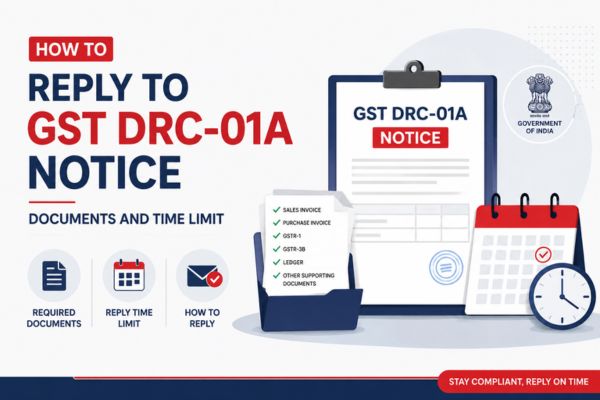
How to Reply to GST DRC-01A Notice Documents and Time Limit
Receiving a proposed GST demand for tax, interest, or penalty is stressful for any business owner. You might be wondering why you received Form GST DRC-01A and what action to take next. Preparing a proper DRC 01A notice reply is the best way to address the issue before it becomes a formal legal dispute.
A DRC-01A is generally a pre-show-cause communication from the tax department. It gives you an early opportunity to review the proposed liability. You can choose to pay the amount, make a partial payment, or explain why you disagree with their calculation.
This guide will help you understand the meaning of this pre-show cause notice. We will cover the common reasons for receiving it, the required documents, the applicable time limit, and the step-by-step process to file your response online.
Quick Answer Box
What is Form GST DRC-01A? It is a pre-show-cause intimation sent by a GST officer under Rule 142(1A) of the CGST Rules. It informs you of a proposed tax liability. Your first step should be to carefully read the notice and match the figures with your GST returns and books of accounts. Filing a timely response with strong supporting documents matters because it can stop the officer from issuing a formal demand notice. Always check your specific facts before accepting any proposed tax, interest, or penalty.
What Is a GST DRC-01A Notice?
A GST DRC-01A is a pre-SCN intimation (pre-show-cause notice). This means it is a communication sent before the tax department takes formal legal action against you. The proper officer issues it to inform you about a difference found during scrutiny, audit, or investigation.
This notice outlines a GST proposed liability. It shows the amount of tax the officer believes you owe, plus applicable GST tax interest and penalty. However, receiving this notice does not automatically mean that the proposed amount is correct or final.
It is very different from a formal show-cause notice (Form DRC-01). An intimation is just a proposal and an invitation to clear up confusion. A formal show-cause notice is a strict legal demand requiring a formal defence.
Simple Example:
Imagine your GSTR-1 shows sales of ₹10 Lakhs, but your GSTR-3B shows sales of ₹8 Lakhs. The GST officer will issue a DRC-01A asking you to pay tax on the remaining ₹2 Lakhs. If you simply made a typing error and can prove it with your sales register, you can clarify this without facing heavy penalties.
Common Reasons for Receiving a DRC-01A Notice
The GST portal uses automated tools to find mismatches in your tax filings. An officer may also manually issue a GST demand notice after an audit.
Here are the most common reasons you might receive this notice:
- GSTR-1 and GSTR-3B difference in reported outward supplies.
- GSTR-2B and GSTR-3B ITC (Input Tax Credit) difference.
- Claiming ineligible input tax credit on blocked items (like cars or food).
- Tax rate classification issue, such as applying a 5% rate instead of 18%.
- Turnover difference between GST returns and your Income Tax audit report.
- E-way bill data difference compared to your filed GSTR-1.
- Reverse charge liability (RCM) not paid on purchases from unregistered transport agencies.
- Unreported outward supply discovered during a department visit.
- Audit or investigation findings by the tax authorities.
- Interest calculation dispute on late-paid taxes.
DRC 01A Notice Reply Options Available to a Taxpayer
When you receive an intimation, you have specific choices. Preparing your DRC 01A notice reply correctly depends on whether you agree or disagree with the officer’s calculations.
You can fully accept the liability and pay it voluntarily. You can also accept a portion of it, pay that part, and dispute the rest. Finally, you can completely disagree with the proposed amount by providing a reasoned explanation with evidence. If the officer made a factual or calculation error, you can request a simple correction.
Here is a breakdown of your options under Rule 142 GST:
| Situation | Action | Form to Use | Documents Needed | Possible Next Step |
|---|---|---|---|---|
| Full Agreement | Accept the liability and make full payment. | DRC-03 for payment, Part B for DRC-01A notice reply. | Payment challan (ARN), working sheet. | Officer issues an acknowledgment (DRC-04) and drops proceedings. |
| Partial Agreement | Pay the accepted part and explain why the remaining amount is incorrect. | DRC-03 for payment, Part B for explanation. | Payment ARN, reconciliation sheet, invoices. | Officer reviews the proof and may drop the remaining amount or issue DRC-01 for the balance. |
| Total Disagreement | Reject the proposed liability with proper supporting evidence. | Part B of Form GST DRC-01A. | Bank statements, ledgers, tax invoices, GST returns. | Officer may accept your explanation or issue a formal DRC-01 notice. |
| Clerical Error | Point out any typing, calculation or mathematical mistake made in the notice. | Part B of Form GST DRC-01A. | Correct calculation sheet, previous return copies. | Officer may correct the error and close the matter. |
DRC-01A Reply Time Limit
The exact DRC-01A reply time limit is always mentioned directly on the first page of the notice you receive. You must locate this date immediately.
You should never wait until the last day to file your GST DRC-01A reply. Gathering old issues the final DRC-01. However, relying on this is risky.
If you miss the deadline mentioned in the notice, the officer will assume you have nothing to say. They will then generate a formal show-cause notice (DRC-01). Once DRC-01 is issued, the matter becomes a formal legal dispute, and late filing should never be treated as a normal strinvoices, reconciling data, and preparing a strong legal draft takes time. Furthermore, the GST portal functionality may allow you to upload a response up until the moment the officer ategy.
Do This Today Checklist:
- Check your GST portal dashboard for the notice issue date.
- Find the exact due date written inside Part A of the notice.
- Mark the deadline on your calendar at least three days early.
- Begin downloading the required GST returns immediately.
Documents Required for DRC-01A Reply
Submitting GST notice supporting documents is the most important part of your defense. A reply without proof is usually rejected. The exact list depends entirely on the reason mentioned in the notice.
Here are the standard documents required for DRC-01A reply preparation:
| Document | Purpose | When It Is Needed | Important Check |
|---|---|---|---|
| Copy of DRC-01A Part A | To reference the exact notice number. | Every reply. | Ensure the notice number is copied correctly. |
| GSTR-1, 3B, 2A, and 2B | To show what was filed on the portal. | Reconciling sales or ITC differences. | Download the JSON or PDF from the portal. |
| Sales & Purchase Register | To prove your actual business transactions. | Mismatch between returns and books. | Must match your audited financials. |
| Tax Invoices | To prove the rate and value of goods/services. | Rate classification or valuation disputes. | Check if GSTIN and HSN codes are correct. |
| Debit & Credit Notes | To show adjustments to original sales. | Differences in GSTR-1 vs GSTR-3B. | Ensure they are linked to the original invoice. |
| E-way Bills & E-invoice | To prove movement of goods. | Turnover or transport disputes. | Check vehicle numbers and dates. |
| Bank Statements & Ledger | To prove payment to suppliers within 180 days. | Reversal of ITC disputes. | Highlight the specific transaction rows. |
| Trial Balance & Audit Report | To show overall financial truth. | Turnover mismatch with Income Tax. | Ensure it is signed by your CA. |
| Vendor Confirmations | To prove the supplier paid the tax. | ITC mismatch issues. | Get a signed letter or ledger from the vendor. |
| Transport / Goods Receipt | To prove goods were actually received. | Fake invoice allegations. | Keep lorry receipts (LR) handy. |
| Bills of Entry | To prove IGST paid on imports. | Import ITC mismatches. | Match it with ICEGATE data. |
| Reconciliation Statement | To map the department’s figure to your figure. | Every complex reply. | Make it simple and easy for the officer to read. |
| DRC-03 ARN | To prove you paid the accepted amount. | Partial or full acceptance. | Ensure the correct financial year is selected. |
| Previous Correspondence | To show past communication. | Ongoing audit or investigation. | Attach previous letters sent to the department. |
How to Prepare a Strong DRC-01A Notice Reply
Writing a strong response requires careful comparison of your books with the tax department’s claims. If you do not know how to file DRC-01A reply documents correctly, follow this drafting process:
Step 1: Read the notice and identify every single allegation made by the officer.
Step 2: Check the tax period and the specific legal provision applied (for example, Sections 73, 74, or 74A depending on the relevant financial year).
Step 3: Reconcile your GST returns with your accounting books to find the root cause of the difference.
Step 4: Separate the amounts you accept from the amounts you dispute.
Step 5: Prepare a point-by-point response addressing each allegation separately.
Step 6: Refer to your supporting documents through clear annexure numbers.
Step 7: Calculate any accepted tax and interest carefully before making a DRC-03 payment.
Step 8: Obtain a professional review if the demanded amount or the legal issue is significant.
Your written reply should always contain:
- Notice reference number and date.
- Your GSTIN and taxpayer name.
- The relevant tax period.
- A short statement of facts explaining your business.
- A point-wise response to the allegations.
- A reconciliation summary table.
- A legal explanation quoting the correct sections.
- A clear list of annexures.
- A clear request or prayer (e.g., requesting the officer to drop the proceedings).
- An authorised signature.
Step-by-Step Process to File DRC-01A Part B on the GST Portal
Filing your DRC-01A Part B reply online is a straightforward process if your documents are ready.
- Log into the GST portal using your valid credentials.
- Navigate to Services > User Services > View Additional Notices and Orders.
- Find the relevant intimation and click on View.
- Click on the Replies tab and select the option to add a reply to open Part B.
- If you have paid any amount, enter the payment details and the DRC-03 ARN.
- Write a brief explanation in the text box provided.
- Upload your detailed written reply and supporting files as PDF attachments.
- Select the authorised signatory and sign the form using a DSC (Digital Signature Certificate) or EVC (Electronic Verification Code).
- Save the generated acknowledgement and ARN (Application Reference Number).
- Take screenshots and download the filed documents for your permanent records.
DRC-01A Problem and Solution Table
Every notice has a different root cause. Here is a practical problem-and-solution guide to help you decide your approach. Clearly state that the final reply depends on your actual records.
| Document | Purpose | When It Is Needed | Important Check |
|---|---|---|---|
| Copy of DRC-01A Part A | To reference the exact notice number. | Every reply. | Ensure the notice number is copied correctly. |
| GSTR-1, 3B, 2A, and 2B | To show what was filed on the portal. | Reconciling sales or ITC differences. | Download the JSON or PDF from the portal. |
| Sales & Purchase Register | To prove your actual business transactions. | Mismatch between returns and books. | Must match your audited financials. |
| Tax Invoices | To prove the rate and value of goods/services. | Rate classification or valuation disputes. | Check if GSTIN and HSN codes are correct. |
| Debit & Credit Notes | To show adjustments to original sales. | Differences in GSTR-1 vs GSTR-3B. | Ensure they are linked to the original invoice. |
| E-way Bills & E-invoice | To prove movement of goods. | Turnover or transport disputes. | Check vehicle numbers and dates. |
| Bank Statements & Ledger | To prove payment to suppliers within 180 days. | Reversal of ITC disputes. | Highlight the specific transaction rows. |
| Trial Balance & Audit Report | To show overall financial truth. | Turnover mismatch with Income Tax. | Ensure it is signed by your CA. |
| Vendor Confirmations | To prove the supplier paid the tax. | ITC mismatch issues. | Get a signed letter or ledger from the vendor. |
| Transport / Goods Receipt | To prove goods were actually received. | Fake invoice allegations. | Keep lorry receipts (LR) handy. |
| Bills of Entry | To prove IGST paid on imports. | Import ITC mismatches. | Match it with ICEGATE data. |
| Reconciliation Statement | To map the department’s figure to your figure. | Every complex reply. | Make it simple and easy for the officer to read. |
| DRC-03 ARN | To prove you paid the accepted amount. | Partial or full acceptance. | Ensure the correct financial year is selected. |
| Previous Correspondence | To show past communication. | Ongoing audit or investigation. | Attach previous letters sent to the department. |
Sample DRC-01A Reply Format
If you are drafting your own response, you can use this basic DRC-01A reply format. Note that this draft must be customised for the taxpayer’s specific facts.
Subject: Reply to Intimation in Form GST DRC-01A Part A
Reference: Notice No. [Insert Number] dated [Insert Date]
Background:
We, [Company Name], holding GSTIN [Insert GSTIN], are engaged in the business of [Business Type]. We received the referenced intimation proposing a tax liability of Rs. [Amount] for the period [Tax Period].
Point-wise Submission:
Regarding the allegation of [Mention the issue, e.g., excess ITC]:
We respectfully submit that the input tax credit claimed matches our books of accounts. The difference occurred because [explain the reason, e.g., the supplier uploaded the invoice in the subsequent month].
Reconciliation:
As per our books: Rs. [Amount]
As per GSTR-2B: Rs. [Amount]
Difference: Rs. [Amount] (Explained in Annexure 1)
Supporting Documents:
We have attached the purchase register and vendor ledgers to prove the genuineness of the transactions.
Payment Details, if any:
We have voluntarily paid Rs. [Amount] towards [mention issue] via DRC-03 ARN [Insert ARN] dated [Insert Date].
Request to Drop the Proposed Liability:
Based on the above facts and attached evidence, we request you to kindly drop the proposed liability and clear the proceedings.
Annexure List:
- Reconciliation Statement
- Copy of GSTR-3B and GSTR-2B
- DRC-03 Payment Challan
DRC-01A vs DRC-01 Difference
Many taxpayers confuse these two forms. Understanding the difference will help you manage your legal risk better.
| Feature | GST DRC-01A | GST DRC-01 |
|---|---|---|
| Meaning | Pre-show-cause intimation. | Formal show-cause notice. |
| Stage of Proceedings | Early stage, before formal demand. | Advanced stage, formal legal demand. |
| Purpose | To give the taxpayer a chance to explain or pay early. | To formally demand tax, interest, and penalty. |
| Reply Form | Part B of DRC-01A. | Form GST DRC-06. |
| Payment Option | Voluntary payment via DRC-03. | Payment via DRC-03, but penalties may be higher. |
| Level of Risk | Low to Medium | High |
| Recommended Action | Reconcile, reply, and resolve the issue quickly. | Requires a detailed, legally strong defense. |
What Happens If DRC-01A Is Ignored?
Ignoring a tax intimation is never a good idea. If you do not submit a reply, the department will assume you have no defense.
The officer will proceed to initiate formal show-cause proceedings. You will then receive the issuance of DRC-01. Once this happens, you will lose the early opportunity to correct the officer’s calculation or settle the matter with lower penalties.
After receiving a formal SCN, you will have a strict deadline to file a detailed DRC-06 reply. Depending on the facts of your case, your tax, interest, and penalty exposure may increase significantly. Taking action at the DRC-01A stage is always safer and more cost-effective.
Common Mistakes in a DRC 01A Notice Reply
A poorly drafted response can cause more harm than good. When preparing a DRC 01A notice reply, avoid these frequent errors:
- Replying without reconciliation: Guessing the numbers instead of matching your books line-by-line with the portal.
- Accepting the full amount without checking: Paying out of fear without verifying if the officer’s calculation is legally correct.
- Uploading unclear documents: Attaching blurry photos or unreadable PDFs that the officer cannot verify.
- Giving one-line answers: Writing “I disagree” without explaining the legal or factual reason.
- Missing annexure references: Providing documents but failing to mention them in your written explanation.
- Using the wrong tax period: Providing data for FY 2021-22 when the notice is for FY 2020-21.
- Ignoring interest calculations: Paying only the tax and forgetting that interest applies to delayed payments.
- Contradicting previous GST returns: Making statements that go against what you previously declared.
- Missing the stated reply date: Filing too late, causing the officer to issue a formal SCN.
- Making unsupported legal claims: Quoting random rules without understanding if they apply to your specific tax period.
- Copying a generic online reply: Using a downloaded template without changing the facts to match your business.
When Should You Take Professional Help?
While simple factual errors can be handled by the taxpayer, certain situations require expert attention. You should consider consulting a GST notice reply consultant if your case involves a large tax demand or allegations of fraud and suppression.
Cases involving multiple financial years, complex ITC disputes, or deep audit investigations usually require a professional eye. If there is an incorrect tax classification, or if a personal hearing and a heavy proposed penalty are involved, expert guidance is highly recommended. Managing several GST registrations across states also increases the complexity of a reply.
If you are unsure about your legal position, taking help early can prevent bigger financial losses. Our team at Jigar Malavaniya & Associates provides comprehensive GST litigation and advisory services to help businesses respond to tax notices accurately and confidently.
Conclusion
Handling a tax intimation does not have to be overwhelming. A well-prepared DRC 01A notice reply can help you resolve disputes before they turn into formal demands. The key is to carefully read the officer’s allegation, reconcile your data with your books, and collect solid evidence.
Always ensure you reply within the mentioned time limit to protect your rights. Keep a record of your filed acknowledgement and all supporting documents. If you find the legal provisions confusing, or if the financial stakes are high, seeking expert help is a smart business decision. If you need assistance understanding your notice, you can book a GST consultation with our experts to secure your business today.
Frequently Asked Questions (FAQs)
A DRC 01A notice reply is a response submitted by a taxpayer in Part B of Form GST DRC-01A. It is used to either accept, partially accept, or completely disagree with a proposed tax liability intimation sent by a GST officer before a formal show-cause notice is issued.
No, it is not a formal show-cause notice. It is a pre-show-cause intimation. It serves as an early communication to inform the taxpayer about a discrepancy, giving them a chance to pay the tax or explain the difference before formal legal proceedings begin.
The exact time limit is printed on the notice itself. While the GST portal may allow submissions until a formal DRC-01 is generated, you should strictly follow the deadline mentioned in your specific intimation to avoid escalating the legal proceedings.
Technically, the GST portal might keep the reply window open until the officer issues the final DRC-01. However, delaying your response is risky. The officer can assume you have no defense and proceed to issue a formal legal demand with higher penalties.
The documents depend on the allegation. Generally, you need your GSTR-1, GSTR-3B, GSTR-2B, sales and purchase registers, tax invoices, bank statements, and a clear reconciliation sheet mapping your books to the department’s calculations.
Payment is only compulsory if you agree with the proposed liability. If you completely disagree with the officer’s calculations and have the evidence to prove your case, you do not need to make a payment. You simply file a detailed explanation in Part B.
Yes, you can partially accept the demand. You can pay the accepted amount using Form DRC-03 and use Part B of the intimation to submit your explanation and evidence for the remaining disputed amount.
The GST officer will review your explanation and documents. If they are satisfied, they may drop the proceedings. If they disagree with your defense or find your evidence insufficient, they will issue a formal show-cause notice (DRC-01).
DRC-01A is an early intimation giving you a chance to clarify a discrepancy peacefully. DRC-01 is a formal show-cause notice demanding tax, interest, and penalties, which requires a strict legal defense under Form DRC-06.
Yes, an experienced GST consultant or Chartered Accountant can analyse the notice, reconcile your books, draft a legally sound response, and file it on the GST portal on your behalf to ensure accuracy and compliance.
Disclaimer: This article provides general information about GST procedures. The correct response depends on the notice, tax period, documents and facts of each case. Obtain professional advice before making any payment or legal submission. If you are unsure how to handle a GST notice, please consult a GST consultant in Ahmedabad.