
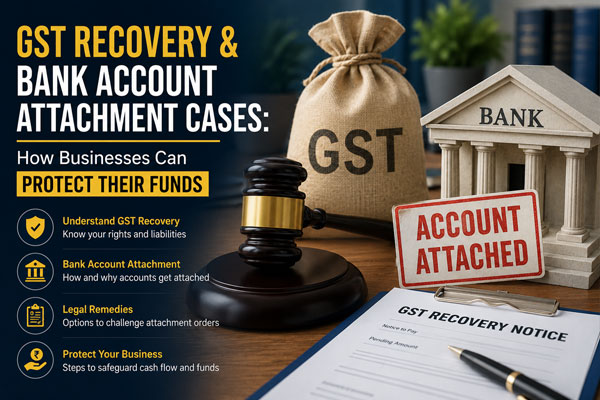
GST Recovery and Bank Account Attachment Cases
Imagine running your business normally, and suddenly you get a notice that your bank account is frozen. Your suppliers can’t be paid. Salaries can’t be processed. This nightmare happens to many businesses through GST recovery proceedings.
If you’re facing this situation—or worried it might happen—this guide will help you understand what’s happening and what you can do about it.
Understanding GST Recovery Proceedings
What is GST Recovery?
GST recovery is when the government (through the GST department) tries to collect unpaid taxes, penalties, or dues from a business. If a business doesn’t pay GST bills on time or disputes aren’t resolved, the GST officer can start recovery proceedings.
Think of it like this: If you owe money to the bank, they can take action to recover it. Similarly, GST authorities can recover what they believe is owed to them.
Why Does This Happen?
Common reasons for GST recovery proceedings:
- You missed paying GST on time
- The GST department noticed a mismatch in your returns
- A supplier was declared “non-genuine” and you claimed credit for their invoices
- You filed wrong input tax credit (ITC) claims
- There’s a disagreement between you and the GST officer about how much you owe
The Problem It Creates
When recovery proceedings start, business comes to a halt. Your bank account gets frozen. You can’t:
- Pay your employees
- Buy raw materials
- Pay suppliers
- Run daily operations
This is why understanding GST recovery proceedings is so important—before it reaches this point.
How Bank Account Attachments Happen Under GST
The Step-by-Step Process
Here’s exactly how your bank account gets attached in a GST attachment of bank account case:
What “Attachment” Means
When your account is “attached,” it means:
- You cannot withdraw money
- Your business operations stop
- You lose credibility with suppliers and customers
- Your business may collapse
This is exactly what happened to hundreds of businesses in Ahmedabad and across India—and it’s preventable if you act early.
Real Example
A small manufacturing business in Ahmedabad got a GST notice for ₹15 lakh. They ignored it, thinking it wasn’t serious. Three months later, their bank account was frozen. They couldn’t pay salaries for 2 months. All employees left. The business shut down—even though the GST amount was later found to be incorrect.
Legal Remedies Against GST Account Attachment
The Good News: You Have Options
If your bank account is attached, don’t panic. You have legal ways to get it unfrozen and recover your funds. Here are your main remedies:
Interim Relief (Stay Order)
If you file an appeal, you can ask the Appellate Authority for “interim relief” or a “stay order.”
What This Means: The attachment is put on hold while your appeal is being decided.
When to Ask:
- Immediately after filing your appeal
- Along with proof of hardship to your business
Success Rate: High (70-80%) if you show genuine hardship
Example: “My appeal is filed against the GST order. I request interim relief to unfreeze my account while the appeal is pending. My business has 50 employees and ₹30 lakh monthly expenses.”
Demand for Personal Hearing
If you haven’t had a chance to explain your position to the GST officer, request a personal hearing.
What Happens: You sit down with the officer and explain why the GST demand is wrong.
Success Rate: Many cases are resolved in this meeting itself because:
- Officers understand your business better
- You can show real documents and prove your position
- Officers often find errors in their own assessment
Demand for Relaxation of Attachment
This is your first and fastest option.
What You Do:
- Write a formal letter to the GST Commissioner
- Ask for the attachment to be relaxed (removed temporarily)
- You don’t need to accept the entire GST demand—just ask for relaxation
When It Works:
- If you can prove genuine hardship to your business
- If you show you’re making payment arrangements
- If you agree to pay part of the amount in installments
Timeline: Usually 7-15 days
Example: “My bank account has been attached, and I cannot pay my 200 employees. I request relaxation of attachment. I am ready to pay ₹2 lakh immediately and the rest in EMI.”
This often works because the GST officer doesn’t want your business to collapse—they want to get paid.
Appeal Against the GST Order
If you believe the GST demand itself is wrong (not just the attachment), file an appeal.
Where to Appeal:
- Appellate Authority (First Appeal)
- Advance Authority (Second Appeal)
- GST Tribunal (Final Appeal)
Why This Works: Many GST orders are passed wrongly. Common mistakes:
- Officer wrongly calculated ITC
- Officer wrongly assessed your turnover
- Officer wrongly declared your supplier as non-genuine
- Officer didn’t follow proper procedure
Timeline: 30 days from the order to file first appeal
Cost: Minimal (filing fees + your time)
Important: File your appeal BEFORE the attachment happens if possible. Prevention is better than cure.
Role of GST Litigation Advocate in Ahmedabad
Why You Need Professional Help
You might be thinking: “Can’t I handle this myself?”
Technically, yes. But here’s the reality: A trained GST litigation advocate in Ahmedabad can:
What a GST Advocate Does:
Immediate Crisis Management
- Demands relaxation of your account attachment within days
- Files urgent applications to unfreeze your funds
- Ensures your business doesn’t collapse
Case Analysis
- Reviews your GST assessment order
- Identifies errors and weaknesses in the GST department’s position
- Calculates your actual liability vs. the demanded amount
Filing GST Appeal
- Prepares detailed appeal documents with strong legal arguments
- Files appeals at the right time (missing deadlines costs you the case)
- Represents you before Appellate Authorities
Negotiation
- Talks to GST officers on your behalf
- Often settles cases at 40-60% of the demanded amount
- Arranges payment plans so your business survives
Tribunal Representation
- If needed, takes your case to GST Tribunal
- Presents your case before judicial authorities
- Fights for your full recovery
What a GST Advocate Does:
Without a GST Advocate:
- You miss filing deadlines (case is lost)
- You don’t know what legal arguments to make (case is lost)
- You accept settlements that are too high
- Your business collapses waiting for resolution
With a GST Advocate:
- Deadlines are met
- Strong legal arguments are presented
- Better settlement rates achieved
- Business continues while case is ongoing
Key Takeaways
✓ GST recovery proceedings start when you don’t respond to GST notices
✓ Bank account attachment can be relaxed even after it happens
✓ You have 3 levels of appeals to fight a wrong GST order
✓ Personal hearings solve 60% of cases before formal appeals
✓ A GST litigation advocate in Ahmedabad can settle cases at 40-60% of demanded amount
✓ Time is critical—every delay reduces your options
What Should You Do Right Now?
If you’ve received a GST notice or your account is attached:
- Don’t panic. You have legal remedies.
- Don’t ignore it. Every day of delay reduces your options.
- Get professional help immediately. Call a GST advocate today.
At Jigar & Associates, we’ve helped 200+ businesses recover their frozen accounts and negotiate better GST settlements.
Call us for a free consultation. Let’s discuss your situation and create a winning strategy for you.
FAQs on GST Recovery & Bank Account Attachment
Yes. File a demand for relaxation of attachment. Most are granted within 7-15 days.
You can arrange to pay in installments. The GST officer usually agrees to EMIs if your appeal is pending.
First appeal: 6-12 months. Second appeal: 12-18 months. GST Tribunal: 18-24 months. But you can get interim relief (stay) within weeks.
Yes. You can recover excess GST paid through refunds or adjustments in future bills.
Not mandatory, but highly recommended. A lawyer increases your success rate from 20% to 80%.
Yes. File your appeal and immediately ask for interim relief. Success rate is 70% if you show hardship.
The GST order becomes final. You lose the right to appeal. Your only option then is a very difficult review petition.