
GSTR-2B and GSTR-3B Mismatch Notice Reply Guide
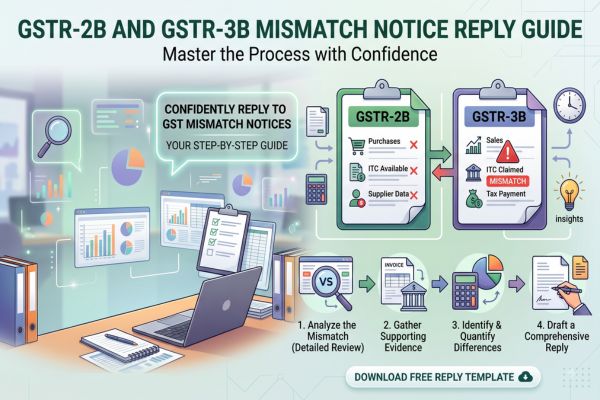
A common problem for taxpayers is finding that the input tax credit claimed in GSTR-3B is higher than the credit available in GSTR-2B. When this happens, the portal generates an intimation. Receiving a GSTR 2B mismatch notice can feel stressful, but it does not always mean you made a mistake.
The difference often arises from a supplier delay, an incorrect GSTIN, an invoice amendment, or a timing issue. It could also happen due to a duplicate claim or an actual ineligible credit. The taxpayer must first reconcile the data instead of immediately paying or ignoring the intimation.
This guide covers everything you need to know. We will explore the reasons for differences, the required documents, how to do a reconciliation, the reply procedure, and preventive steps for your business.
Quick Answer
A GSTR-2B and GSTR-3B mismatch means you claimed more input tax credit (ITC) in your GSTR-3B return than what is reflected in your system-generated GSTR-2B statement. The GST portal issues Form GST DRC-01C to ask for an explanation or payment. First, taxpayers must check if the difference is due to timing, supplier errors, or genuine excess claims. DRC-01C requires you to reply within seven days by either paying the excess amount or explaining the difference in Part B. An invoice-level reconciliation is necessary to prove your correct ITC claim and avoid facing GSTR-1 filing restrictions.
What Is a GSTR 2B Mismatch Notice?
A GSTR 2B mismatch notice is an automated system intimation sent to taxpayers. GSTR-2B is a static, auto-generated statement showing the eligible ITC based on your suppliers’ filings. The ITC claimed in GSTR-3B is the actual credit you declare to offset your tax liability.
The GST portal automatically compares these two figures. A difference is identified when the ITC claimed in GSTR-3B exceeds the GSTR-2B ITC by a specific percentage and amount. It is important to note that a simple reconciliation difference is not always a formal notice.
However, if the portal triggers an alert under Rule 88D, you will receive Form GST DRC-01C. Taxpayers should always check whether the communication is Part A of DRC-01C, a scrutiny notice like ASMT-10, or a pre-show cause notice like DRC-01A. The reply procedures for each form are very different.
GSTR-2B vs GSTR-3B Meaning
To understand the GSTR-2B and GSTR-3B mismatch, you must know how these forms work. GSTR-2B is an auto-generated statement. GSTR-3B is the return in which the taxpayer actually reports and claims eligible ITC.
| Feature | GSTR-2B | GSTR-3B |
|---|---|---|
| Purpose | To show ITC available based on supplier filings. | To declare tax liability and claim ITC. |
| Source of Data | Auto-drafted from suppliers’ GSTR-1 or IFF. | Manually entered or auto-populated by the taxpayer. |
| Who Controls the Data | Controlled by the supplier’s return filing actions. | Controlled by the recipient taxpayer. |
| Can Values Be Edited | No, it is a read-only static statement. | Yes, taxpayers can edit the auto-populated figures. |
| Role in ITC Reconciliation | Acts as the base document for available credit. | Acts as the final claim document for eligible credit. |
Why Does GSTR-2B and GSTR-3B Mismatch Occur?
A GSTR-3B ITC mismatch does not automatically mean the taxpayer claimed wrongful ITC. Differences happen for many routine business reasons. Here are the most common causes:
- Supplier filed GSTR-1 late: The supplier filed their return after the GSTR-2B cutoff date, moving the credit to the next month’s statement.
- Supplier entered the wrong GSTIN: The invoice was uploaded against another taxpayer’s GSTIN, so your GSTR-2B ITC is not showing it.
- Supplier reported the invoice in a later month: The supplier completely missed the invoice and uploaded it in a subsequent tax period.
- Invoice was amended: The supplier changed the invoice value or tax amount in a later month, creating a difference.
- Credit note was issued: The supplier issued a credit note that reduced the available ITC, but you did not account for it in GSTR-3B.
- Debit note was missed: You claimed ITC based on a debit note that the supplier forgot to upload.
- Invoice was claimed twice: An accounting error caused the same invoice to be claimed in two different tax periods.
- ITC was claimed in the wrong tax period: The ITC was recorded in your books in one month but claimed in a different month.
- Import ITC timing difference: ITC on imported goods was claimed in GSTR-3B, but customs data took time to reflect in GSTR-2B.
- Reverse charge entry issue: RCM liability was paid and claimed, but there is a mismatch with the auto-populated figures.
- ISD credit timing issue: Input Service Distributor credits were distributed but claimed in a different tax period.
- Reclaimed ITC was not identified properly: ITC reversal and reclaim entries were made, but they triggered a mismatch alert.
- Blocked credit was claimed: You accidentally claimed ITC that is blocked under Section 17(5).
- Purchase register contains an unrecorded cancellation: A purchase was cancelled, but the ITC was not reversed in your books.
- Supplier invoice is missing from portal data: The supplier not filing GSTR-1 completely removes the invoice from your GSTR-2B.
- Incorrect place of supply: The supplier chose the wrong state, making the credit ineligible in your state.
- Invoice date or number mismatch: Clerical errors in the invoice details caused the system to treat it as a different document.
What Is Form GST DRC-01C Under Rule 88D?
Rule 88D GST provisions manage situations where excess ITC is claimed. When ITC claimed in GSTR-3B exceeds the ITC available in GSTR-2B above the applicable system criteria, an intimation is issued. This intimation comes in Part A of Form GST DRC-01C.
Rule 88D provides a strict seven-day response period. You should always check the exact due date printed on your intimation. You have two main options to resolve it. You can pay the excess ITC with applicable interest through DRC-03. Alternatively, you can submit a proper explanation for the difference through a DRC-01C reply in Part B. You can also make a partial payment and explain the balance amount.
Failure to pay or reply within the time limit has serious consequences. It may restrict your subsequent GSTR-1 or IFF filing. It may also lead to further demand proceedings.
Simple Process Flow:
Mismatch identified → DRC-01C Part A issued → Reconcile data → Pay, explain or partly pay → File Part B → Save acknowledgement → Follow further communication.
What to Do Immediately After Receiving a GSTR 2B Mismatch Notice
Taking fast, organized action is essential when you receive this intimation. Use this step-by-step checklist to handle it correctly:
- Download the complete intimation from the GST portal.
- Note the reference number and the exact due date for your reply.
- Identify the specific tax periods mentioned in the notice.
- Compare the tax-wise figures for IGST, CGST, SGST and cess.
- Download the GSTR-2B statement for each relevant month.
- Export your filed GSTR-3B ITC figures for the same periods.
- Compare these portal figures with your internal purchase register.
- Mark differences as eligible, ineligible, temporary or duplicate.
- Contact suppliers immediately for any missing invoices.
- Prepare a detailed invoice-level reconciliation statement.
- Calculate any amount that is genuinely ineligible and must be reversed.
- Draft and file DRC-01C Part B before the portal deadline expires.
If you need expert help with this process, obtaining GST notice reply assistance can protect your business from costly mistakes.
Documents Required for GSTR-2B Mismatch Notice Reply
The documents you need depend entirely on the reason for the difference. Attaching the right evidence helps the tax officer understand your claim.
| Document | Why It Is Required | What to Verify | Suggested Annexure |
|---|---|---|---|
| DRC-01C Part A | Base document of the issue. | Reference number and date. | Annexure 1 |
| GSTR-2B & GSTR-3B | Proves the portal figures. | Tax periods match the notice. | Annexure 2 |
| Purchase Register | Shows your internal accounting. | Entries match your GSTR-3B claim. | Annexure 3 |
| Tax Invoices | Proves the actual purchase. | Correct GSTIN and tax amounts. | Annexure 4 |
| Credit/Debit Notes | Explains value changes. | References original invoice details. | Annexure 5 |
| E-way Bills & LRs | Proves movement of goods. | Vehicle details and delivery dates. | Annexure 6 |
| Bank Payment Proof | Fulfills Section 16 conditions. | Payment made within 180 days. | Annexure 7 |
| Import Bill of Entry | Supports import ITC claims. | ICEGATE data matches the claim. | Annexure 8 |
| DRC-03 ARN | Proves payment of excess ITC. | Correct tax heads and interest. | Annexure 9 |
| Reconciliation Statement | Summarizes the entire defense. | Invoice-level details are accurate. | Annexure 10 |
How to Reconcile GSTR-2B, GSTR-3B and Purchase Register
An input tax credit reconciliation requires comparing three sets of data. You must compare your purchase register against GSTR-2B and GSTR-3B. This three-way method reveals exactly where the problem originated.
Here is an illustrative example of an invoice-level reconciliation statement (all figures are fictional):
| Invoice Number | Supplier GSTIN | Purchase Register ITC | GSTR-2B ITC | GSTR-3B ITC Claimed | Reason for Difference | Action Required |
|---|---|---|---|---|---|---|
| INV-101 | 24AAAAA1111A1Z1 | ₹10,000 | ₹10,000 | ₹10,000 | Fully matched. | None. |
| INV-102 | 24BBBBB2222B2Z2 | ₹5,000 | ₹0 | ₹5,000 | Invoice missing in GSTR-2B. | Follow up with supplier. |
| INV-103 | 24CCCCC3333C3Z3 | ₹8,000 | ₹0 | ₹8,000 | Supplier filed late; shown in next month. | Explain timing difference. |
| INV-104 | 24DDDDD4444D4Z4 | ₹12,000 | ₹12,000 | ₹24,000 | Duplicate ITC claim in GSTR-3B. | Pay through DRC-03. |
| CN-001 | 24EEEEE5555E5Z5 | -₹2,000 | -₹2,000 | ₹0 | Credit note missed in GSTR-3B. | Reverse excess ITC. |
| BOE-999 | Customs Port | ₹50,000 | ₹0 | ₹50,000 | Import ITC not auto-populated. | Attach Bill of Entry. |
GSTR 2B Mismatch Notice Problem and Solution Table
Different problems require different solutions. You must map every mismatch to a logical corrective action.
| Mismatch Problem | Likely Reason | Document to Check | Possible Corrective Action | Reply Explanation |
|---|---|---|---|---|
| Missing Invoice | Supplier not filing GSTR-1. | Supplier ledger. | Ask supplier to file. | Explain the supplier default. |
| Timing Issue | Supplier filed late. | Next month’s GSTR-2B. | None; ITC is valid. | Cite next month’s GSTR-2B data. |
| Duplicate Claim | Accounting error. | GSTR-3B history. | Pay excess ITC through DRC-03. | Provide DRC-03 ARN. |
| Credit Note Mismatch | Credit note ignored. | Supplier emails. | Reverse the credit. | Provide DRC-03 ARN. |
| Wrong GSTIN | Supplier typo. | Supplier invoice. | Request an amendment. | Explain amendment pending. |
| Import IGST Mismatch | ICEGATE delay. | Bill of Entry. | Retain the credit. | Attach customs document. |
| Typing Error | Manual entry mistake. | GSTR-3B vs Books. | Pay the excess part. | Explain the clerical error. |
| Blocked Credit | Claimed Section 17(5) ITC. | Invoice nature. | Reverse the ITC. | Admit error and provide ARN. |
| ITC Reclaim Issue | Wrong reporting. | Reversal ledger. | Adjust reporting. | Show reversal history. |
| Cancelled Purchase | Goods returned. | E-way bill. | Reverse the ITC. | Provide DRC-03 ARN. |
How to Decide Whether to Pay or Submit an Explanation
Choosing between a DRC-03 payment and a DRC-01C Part B explanation is critical. Accepting a difference without checking may cause unnecessary cash loss. However, rejecting a valid liability without evidence may increase your legal risk.
| Situation | Pay Through DRC-03 | Submit Explanation | Take Professional Review |
|---|---|---|---|
| Duplicate ITC is confirmed. | Yes, with interest. | No. | No. |
| Invoice belongs to another GSTIN. | Yes, reverse it. | No. | No. |
| Supplier uploaded invoice later. | No. | Yes, show next month 2B. | No. |
| Import document supports credit. | No. | Yes, attach Bill of Entry. | No. |
| Credit is blocked under Sec 17(5). | Yes, with interest. | No. | No. |
| Difference is a complex portal issue. | No. | Yes, with details. | Yes. |
| Large amounts across several years. | No. | Yes. | Yes. |
ITC eligibility depends on current Section 16 conditions, restrictions under Section 17, return data, tax period, and available evidence. Supplier default alone does not always protect the recipient’s ITC. If you are unsure, speak to a GST litigation consultant before making a decision.
How to File DRC-01C Part B on the GST Portal
Filing the reply is a technical process. Always confirm the latest GST portal navigation before submitting, as menus frequently update.
- Log in to the GST portal with your valid credentials.
- Navigate to Services > Returns > Return Compliance.
- Select the ‘Liability Mismatch DRC-01B/DRC-01C’ option.
- Open the specific DRC-01C intimation.
- Carefully review the figures in Part A.
- If you made a payment, enter the DRC-03 ARN in the payment section.
- Indicate whether your payment is full or partial.
- Select the relevant reason codes for any unpaid amount.
- Enter a clear explanation for the unpaid difference in the text box.
- Upload your reconciliation statement and supporting documents in PDF format.
- Submit the form using EVC or a Digital Signature Certificate (DSC).
- Download and save the final acknowledgement.
- Check your portal dashboard to ensure GSTR-1 or IFF access is active.
How to Draft a Strong DRC-01C Reply
A strong GST mismatch notice reply relies on facts, not just arguments. Your submission must be structured logically so the officer can easily verify your claims.
Your draft should include:
- Reference number and taxpayer details.
- The specific tax period involved.
- A brief summary of the mismatch amount.
- The final reconciliation result.
- The accepted amount, if any.
- DRC-03 payment details, including interest.
- A factual explanation for the disputed amount.
- Invoice-level supporting facts.
- A clear index of the annexure list.
- A respectful request to drop the proceedings.
Sample GSTR-2B Mismatch Reply Format
This is an educational format to help you structure your response. This format must be customized based on your taxpayer data and specific facts.
Subject: Reply to Intimation in Part A of Form GST DRC-01C
Reference Number: [Insert Number]
GSTIN: [Insert GSTIN]
Relevant Tax Period: [Insert Month/Year]
Background:
We have received the intimation under Rule 88D regarding a difference between the ITC claimed in GSTR-3B and the ITC available in GSTR-2B.
Summary of Difference:
The total difference indicated is Rs. [Amount]. We have conducted a thorough GST vendor reconciliation.
Amount Paid Through DRC-03:
We accept a difference of Rs. [Amount] due to [Reason, e.g., clerical error]. This has been paid via DRC-03 ARN [Insert ARN] dated [Insert Date], along with applicable interest.
Explanation for Remaining Difference:
The balance difference of Rs. [Amount] is eligible ITC. This difference is purely due to [Reason, e.g., timing differences where suppliers filed returns in the subsequent month]. The credit fulfills all conditions under Section 16 of the CGST Act.
Invoice-Level Reconciliation & Documents:
We have attached the GSTR-2B and books mismatch reconciliation statement as Annexure A, along with copies of tax invoices and e-way bills as Annexure B.
Request:
We request you to take the above facts on record, accept our explanation, and kindly drop any further proceedings in this matter.
Authorised Signatory
[Name and Designation]
For a completely customized response, reading a professional GST notice reply guide can provide more specific legal context.
What Happens If DRC-01C Is Not Replied To?
Ignoring Form GST DRC-01C is a major compliance risk. Rule 88D mandates a seven-day response period. If you do not reply or pay within this time limit, the portal will automatically restrict you from filing your outward supply return (GSTR-1) or using the Invoice Furnishing Facility (IFF).
Furthermore, failing to respond triggers further demand proceedings. The tax department may issue a show-cause notice under Section 73, Section 74, or the newly introduced Section 74A, depending on the relevant tax period and facts. You will also face interest exposure where excess ITC was wrongly availed and utilized. This leads to severe business compliance disruption.
Common Mistakes in a GSTR-2B Mismatch Reply
Many taxpayers face rejected explanations because they make avoidable errors in their DRC-01C Part B submission.
- Comparing only total figures instead of doing invoice-wise checking.
- Ignoring invoice-level differences that hide underlying errors.
- Paying the full amount in panic without checking for simple timing differences.
- Giving a generic reply without factual backing.
- Not attaching an invoice-level reconciliation statement.
- Missing supplier amendments that changed the ITC value.
- Ignoring credit notes, which artificially inflates the claim.
- Failing to separate eligible ITC from permanently ineligible ITC.
- Entering the wrong DRC-03 ARN in the reply form.
- Missing the strict seven-day compliance period.
- Claiming that the supplier is fully responsible without providing evidence.
- Uploading unreadable, blurry, or password-protected files.
How to Prevent Future GSTR-2B and GSTR-3B Mismatches
Preventing a notice is always easier than replying to one. Implement this monthly control checklist to keep your GST records clean.
- Download GSTR-2B before filing any GSTR-3B return.
- Reconcile supplier-wise and invoice-wise every single month.
- Create a pending-invoice tracker for missing credits.
- Follow up aggressively with non-compliant suppliers.
- Check that the GSTIN, invoice date, and invoice number match exactly.
- Review all credit notes issued by your vendors.
- Maintain accurate ITC reversal and reclaim records in your books.
- Separate blocked credit immediately during data entry.
- Match import documents with ICEGATE data before claiming.
- Keep monthly reconciliation approval records signed by management.
- Conduct quarterly vendor compliance reviews.
When Should You Consult a GST Professional?
While routine timing differences can be handled internally, certain situations require expert legal intervention. You should seek professional help if:
- You are dealing with a high-value mismatch.
- The notice covers multiple tax periods or financial years.
- There is any fraud or suppression allegation involved.
- The excess ITC was already fully utilized.
- The supplier’s GST registration was cancelled retroactively.
- The issue involves complex import or ISD credit rules.
- You have complex ITC reversal and reclaim entries.
- Your GSTR-1 filing is already blocked.
- A further demand notice has been issued.
- Your internal books and GST returns do not match at all.
If you are facing any of these issues, it is highly recommended to discuss your GST mismatch notice with an expert to secure your ITC
Conclusion
Handling a GSTR 2B mismatch notice requires a calm and systematic approach. Always read the form number carefully to understand what is being asked. You must work quickly to meet the seven-day deadline for Form GST DRC-01C. Perform a detailed invoice-level reconciliation to separate valid timing differences from actual excess ITC claims. Pay through DRC-03 only after thoroughly checking your records. When submitting your explanation in Part B, always attach proper documents and save the final acknowledgement. If you need dedicated GST input tax credit and litigation support, consulting a professional ensures your response is legally sound and protects your business from unnecessary demands.
Frequently Asked Questions (FAQs)
A GSTR 2B mismatch notice is an automated intimation generated by the GST portal when the input tax credit claimed in your GSTR-3B return exceeds the eligible credit available in your auto-populated GSTR-2B statement by a predefined limit.
This happens for several reasons. Your supplier might have filed their GSTR-1 late, entered the wrong GSTIN, or missed uploading the invoice. It can also occur due to duplicate ITC claims, typing errors, or timing differences involving imported goods.
Form GST DRC-01C is the official intimation issued under Rule 88D. Part A notifies the taxpayer of the ITC mismatch. Part B is the section where the taxpayer must submit their reply, either providing payment details or an explanation.
Rule 88D mandates a strict seven-day time limit to respond to Form GST DRC-01C. Taxpayers must either pay the excess amount or file an explanation in Part B before this deadline to avoid compliance restrictions.
No. Payment is only required if you have genuinely claimed excess or ineligible ITC. If the mismatch is due to a timing difference, a supplier error, or an import delay, you can submit a factual explanation instead of paying.
Yes, you can explain a supplier delay. You should mention that the supplier uploaded the invoice in the subsequent month and attach the following month’s GSTR-2B as proof that the tax was eventually paid to the government.
You should attach an invoice-level reconciliation statement, copies of disputed tax invoices, e-way bills, bank payment proofs, and any communication with the supplier. The exact documents depend on the specific reason for the mismatch.
Yes. If you fail to submit a reply in Part B of DRC-01C or fail to pay the required amount within the seven-day period, the GST portal will automatically restrict you from filing your subsequent GSTR-1 or using the IFF.
If an invoice is missing from your GSTR-2B, you should contact the supplier to upload it. Once it reflects in your GSTR-2B, you can claim the eligible ITC, provided it is within the legal time limits prescribed under Section 16(4).
You can avoid mismatches by downloading GSTR-2B before filing GSTR-3B every month. Perform an invoice-wise reconciliation, track missing credits, follow up with non-compliant vendors, and maintain clear records of all ITC reversals and reclaims.